
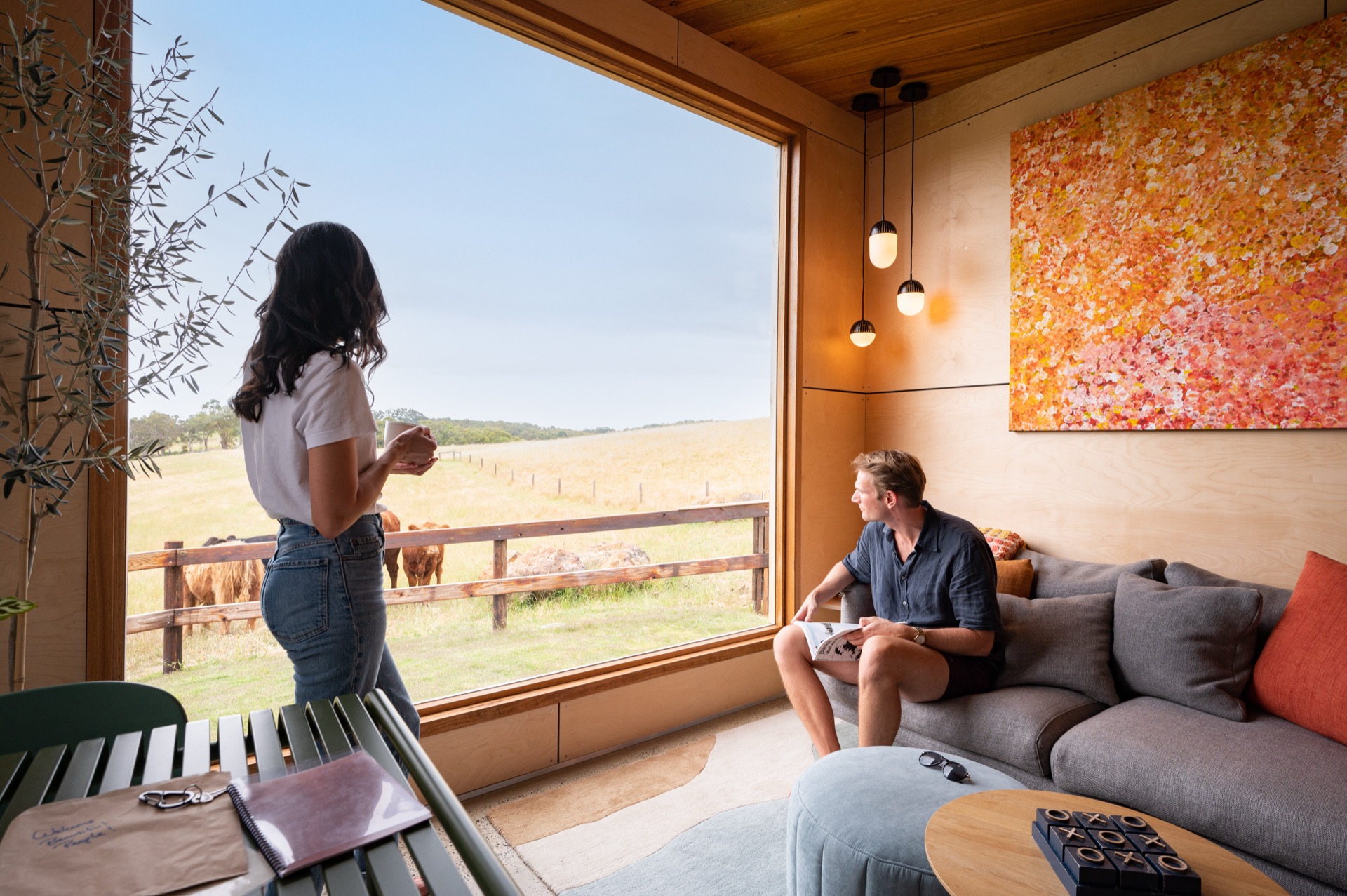
There are a lot of places in South Australia that call themselves a farm stay. Some of them are farms. Some of them are stays. Not many are both.
The difference matters. A farm stay is not just a house in a paddock. It is an experience shaped by the land, the animals, the seasons, and the people who work the property. When it is done well, it stays with you longer than any hotel ever could.
If you are searching for a farm stay in South Australia, here is what to look for — and what to expect — when booking near Adelaide.
What actually makes it a farm stay
The word gets used loosely. A cottage on a rural block is not really a farm stay. Neither is a bed and breakfast that happens to have a view of someone else's sheep.
A real farm stay sits on a working property — or at least a property that is actively managed. There are animals. There are routines. The landscape is not decorative. It is functional. You wake up to the sounds of a place that was doing its thing long before you arrived.
That is the difference. You are not visiting the country. You are briefly part of it.
You hear the tractor start at dawn. You see the cattle move across the paddock in the morning. You learn that the roosters do not care what time you wanted to sleep in. The farmhouse cat shows up on the verandah, judges you, and leaves. These are not experiences a hotel can manufacture.
When people talk about the feeling of a farm stay — the thing that makes them come back — they are usually describing this. The sense that the place is real. That it exists whether you are there or not. That you are a guest in something alive, not a customer in something built for you.
The regions worth knowing for a farm stay in South Australia
South Australia has several pockets where farm stays cluster, each with a different character.
Adelaide Hills
Close enough to the city for a last-minute escape. Twenty-five to forty minutes from the CBD and you are in rolling green hills, orchards, and small-batch producers. The Hills suit people who want seclusion without remoteness. Towns like Hahndorf, Stirling, and Lobethal are nearby when you want a good meal or a cellar door visit.
The Adelaide Hills is also one of Australia's best cool-climate wine regions. A farm stay in the Adelaide Hills means you can spend the morning with cattle in the paddock and the afternoon at a cellar door ten minutes away. That combination is hard to find elsewhere.
The landscape up here is green most of the year. Eucalyptus forest, introduced oaks and elms, orchards, and open pasture. In autumn, the deciduous trees along the main streets of Hahndorf and Stirling turn gold and red. In winter, fog sits in the valleys until mid-morning and the hills look like somewhere in the English countryside. In spring, the orchards blossom and the wildflowers come through.
We wrote a full guide to things to do in Hahndorf and an Adelaide Hills weekend itinerary if you want to plan what you will do between doing nothing.
Fleurieu Peninsula
South of Adelaide, stretching toward Victor Harbor and the coast. The Fleurieu combines farmland with proximity to beaches and McLaren Vale wine country. It is a good pick if you want variety in a short trip.
Farm stays on the Fleurieu tend to sit on grazing properties with coastal views or in the rolling hills behind McLaren Vale. The landscape is drier than the Adelaide Hills — golden grass in summer, green in winter — with a character that feels more pastoral.
The advantage of the Fleurieu is range. You can wake up on a farm, drive to a beach for the morning, have lunch in a McLaren Vale winery, and be home for sunset. Victor Harbor, Goolwa, and Port Elliot each have their own character. From June to September, southern right whales calve in Encounter Bay and you can see them from the shore.
Barossa Valley
Famous for wine, but the pastoral land surrounding the vineyards is quietly beautiful. Farm stays here tend to sit on the edges of the valley, where the vines give way to grazing country and old stone fences.
The Barossa is drier and warmer than the Hills. The landscape is golden most of the year — dry grass, old stone churches, vineyards in neat rows running up gentle slopes. It has a different beauty. More open. More European, maybe, which makes sense given the German and Silesian heritage of the families who settled here.
A farm stay in the Barossa puts you close to some of Australia's best wineries — Seppeltsfield, Hentley Farm, Rockford — and the Barossa Farmers Market on Saturday morning is one of the best in the country.
Clare Valley
Further north, drier, more rugged. Clare suits travellers who want space and solitude. The riesling does not hurt either.
The valley is about ninety minutes from Adelaide. The farms up here run larger — broader paddocks, bigger sky, fewer people. The Clare Valley Riesling Trail is a walking and cycling path that runs through the vineyards and is one of the best wine trails in Australia.
Farm stays in Clare feel more remote than the Hills or the Barossa. That is part of the appeal. If you want to sit on a verandah and see nothing but paddocks in every direction, Clare delivers.
Working farm vs lifestyle property
This is a question worth asking before you book. A working farm has stock, fencing, seasonal rhythms. You might hear a tractor at dawn. You might watch cattle being moved through gates. You might find eggs under the chook house that morning. That is the texture of the experience.
A lifestyle property is quieter. Manicured. More predictable. The grounds are maintained for appearance rather than function. Neither is wrong — they just deliver different things. Know which one you are booking.
Working farms also have a rhythm that changes through the year. Lambing season in spring. Hay baling in summer. Cattle sales in autumn. The property you visit in March will feel different in July. That seasonal variation is part of what makes a farm stay interesting on repeat visits — you see the same place at different stages of its year.
Self-contained vs hosted
Some farm stays are fully self-contained. You have your own kitchen, your own space, your own schedule. Nobody knocks on the door. This suits couples who want privacy and the freedom to do nothing on their own terms.
Hosted stays are more social. Breakfast appears. Someone tells you where to walk. You get the local knowledge that only comes from the people who live there.
Again — different, not better or worse. But it changes the shape of your trip.
For couples, self-contained is usually the better choice. You set your own pace. You eat when you want to eat. You sleep in without feeling guilty that someone is waiting to serve breakfast. The privacy also means the property feels like it is yours for the weekend — not a shared space where you are conscious of other guests.
At Casa Luna, we went fully self-contained for this reason. The kitchen is stocked with breakfast provisions — local bread, eggs from up the road, good butter, seasonal fruit. You cook when you want. You eat on the verandah. Nobody is watching the clock.
The off-grid factor
There is a growing number of travellers who specifically seek properties with limited connectivity. No television. Patchy phone signal. Maybe solar power and tank water.
This is not a limitation — it is the point. When the distractions disappear, the place itself becomes the entertainment. You read. You cook. You sit outside and watch the light change. It sounds simple because it is. That is also why it works.
Off-grid farm stays take this further. Solar panels, rainwater tanks, no mains connection. The house runs on sunlight and rain. You are living, briefly, the way the land allows.
If this interests you, we wrote a separate piece on off-grid accommodation in South Australia that goes into more detail about what to expect and what to pack.
The animals
Nobody expects the animals to be the highlight. But they usually are.
Highland cattle standing in morning fog. Chickens following you across a yard. A curious goat watching you from a fence post. A kookaburra that shows up on the same branch every morning and laughs at six-thirty whether you are ready for it or not.
These are the moments people photograph, talk about at dinner, remember months later. There is something about being close to animals in their own environment — not a zoo, not a petting farm, just animals going about their day — that reconnects something in people.
At Casa Luna, the Highland cattle are the stars. They are gentle, curious, and photogenic. Guests spend more time photographing the cattle than almost anything else on the property. The chickens are less dignified but equally entertaining. And the wild birds — kookaburras, rosellas, magpies, the occasional wedge-tailed eagle riding thermals above the valley — make the mornings feel like something out of a nature documentary.
If a property has animals you can interact with — even just observe — it adds something that no amount of interior design can replicate.
Seasonal considerations for a farm stay in South Australia
South Australia's farm country shifts dramatically through the year. Each season offers something different.
Winter (June to August) — Green hills, wood fires, fog in the valleys. This is when the landscape is at its most dramatic. A good farm stay will have a fire pit or a fireplace. Use it. Winter mornings in the Adelaide Hills are cold — near freezing sometimes — and the fog sits in the valleys until mid-morning. It is beautiful. The outdoor bath hits differently when the air is three degrees and the water is forty.
Spring (September to November) — Wildflowers, newborn lambs, long golden afternoons. Spring is arguably the best time for a farm stay in the Adelaide Hills. Everything is alive. The orchards blossom. The hills are green. The days are getting longer and the evenings are warm enough to sit outside.
Summer (December to February) — Warm evenings, stone fruit, dry grass. Bring sunscreen and a hat. Find a property with shade and a good verandah. Summer evenings in the hills are beautiful — the temperature drops when the sun goes down and the stars come out against a warm sky. Cherry season runs through December and early January, and the pick-your-own orchards around Lenswood and Forest Range are worth visiting.
Autumn (March to May) — Harvest season, cooler nights, turning leaves. Quieter than spring and summer, which is part of the appeal. The wine harvest is happening in the surrounding vineyards. The light turns golden. The deciduous trees along the main streets of the hills towns are at their best.
What to pack for a farm stay
Farm stays are not hotels. A few things worth remembering:
- Layers. Mornings and evenings are cooler than you expect, especially in the Hills. Even in summer, a light jacket is worth having.
- Shoes you do not mind getting dirty. Grass will be wet. Paths will be muddy after rain. Leave the white sneakers at home. If you want to walk the property, boots or trail shoes are ideal.
- Groceries. If you are self-contained, stock up before you arrive. The nearest shop might be a twenty-minute drive. The Adelaide Central Market is an excellent place to buy provisions.
- A book. You will actually read it. The quiet and the absence of screens make reading feel different. Better.
- Wine. Buy a couple of bottles from the cellar doors you visit, or bring something from home. Having wine on the verandah at sunset is half the experience.
- Nothing else. Seriously. The less you bring, the more you notice.
Our approach at Casa Luna
We built Casa Luna as the farm stay we wanted to find but could not. A self-contained home on a working property in the Adelaide Hills. Highland cattle in the paddock. A fire pit under old eucalypts. An outdoor bath under stars. A far-infrared sauna. Netflix if you want it, silence if you do not. Close enough to Hahndorf and Stirling for a day out, quiet enough that you forget the city exists.
It is not a hotel dressed up as a farm. It is a farm that happens to have a very comfortable place to stay on it. The distinction matters to us because it shapes everything — where the house sits, what you see from the verandah, how your morning sounds.
We are three minutes from Hahndorf, twenty-five from Adelaide's CBD, and surrounded by some of the best wine country in Australia. You can read more about the property or check availability and book your stay.
It is not for everyone. But for the right couple, it is exactly right.