
Winter Escapes in the Adelaide Hills: The Case for Cold Weather
April 9, 2026 · Adelaide Hills
Most people come to the Adelaide Hills in summer. Long days, blue skies, busy cellar doors. It's lovely. But if you ask anyone who actually lives here, they'll tell you the same thing — winter is when the hills are at their best.
We're not being contrarian. It's just true.
Winter escapes in the Adelaide Hills are a different kind of holiday. Not the kind where you chase sunshine and activity. The kind where the weather gives you permission to slow down, stay warm, and do nothing in particular. For couples looking for a reason to get away mid-year, this is it.
The mood changes everything
There's a particular morning in May when you wake up and the valley has disappeared. Fog sits heavy between the ridgelines. The trees are just outlines. Everything is quiet in a way that summer never allows.
The green comes back — not the tired, sun-bleached green of February, but a deep, saturated green that makes the whole landscape feel new. The air smells like wet eucalyptus and wood smoke. The roads are empty. The light is soft all day.
This is the Adelaide Hills in winter. It's not something you endure. It's something you come for.
The hills sit between 400 and 700 metres above sea level. That elevation means real seasons — not the mild, grey winters of the Adelaide plains, but genuine cold. Morning frosts. Single-digit temperatures. The kind of weather that makes a fire feel necessary, not decorative.
It also means the landscape transforms. Deciduous trees in Hahndorf and Stirling turn gold and red. The creeks run again. The waterfalls at Waterfall Gully and Morialta are at their best. The hills look like a different region entirely — more like Tasmania or the Dandenong Ranges than anything you'd expect twenty minutes from Adelaide.
Fire pit season
From May through October, we provide firewood for the outdoor fire pit at Casa Luna. Split hardwood, stacked and ready.
There's something about sitting by a fire when the air is genuinely cold. Not the manufactured cosiness of a gas heater in a city apartment — real cold, real fire, real stars overhead. The kind of evening where you pull a blanket around your shoulders and don't say much.
The fire pit at Casa Luna is set apart from the cottage, out in the open where you can see the valley and the sky. In winter, the stars are sharper than any other season — less humidity, less haze, more depth. On a clear night in June or July, you can see the Milky Way from the fire pit. That's not a marketing claim. That's a Tuesday.
We leave marshmallows in the provisions. Some couples make a ceremony of it. Others just sit and watch the flames. Both are correct.
Most guests tell us the fire pit was the highlight of their stay. In winter, we understand why. There is something primal about fire in cold air. Your body relaxes differently. Conversation goes to different places. The day feels finished in the best possible way.
The sauna at five degrees
The infrared sauna sits in its own space with glass walls looking out into the bushland. In summer it's pleasant. In winter it's transformative.
Picture this: it's 5 degrees outside. Maybe less. The sauna is sitting at 60 degrees. You're looking through the glass at fog moving through the trees, completely warm, completely still. The contrast between inside and outside is so sharp it feels like you've stepped into a different climate.
Then you step outside and the cold hits your skin and you feel more awake than you have in months.
It's the contrast that makes it. You can't get that feeling in October. You need a proper cold morning. The Scandinavians have known this for centuries — hot sauna, cold air, repeat. Your circulation surges. Your skin tingles. Something resets in your nervous system that warmth alone can't achieve.
Winter sauna sessions are longer, too. In summer, people do twenty minutes and they're done. In winter, guests settle in for thirty or forty minutes, watching the weather change through the glass, letting the heat build slowly. There's no clock in there. No screen. Just glass and trees and the sound of rain on the roof.
The outdoor bath, after dark
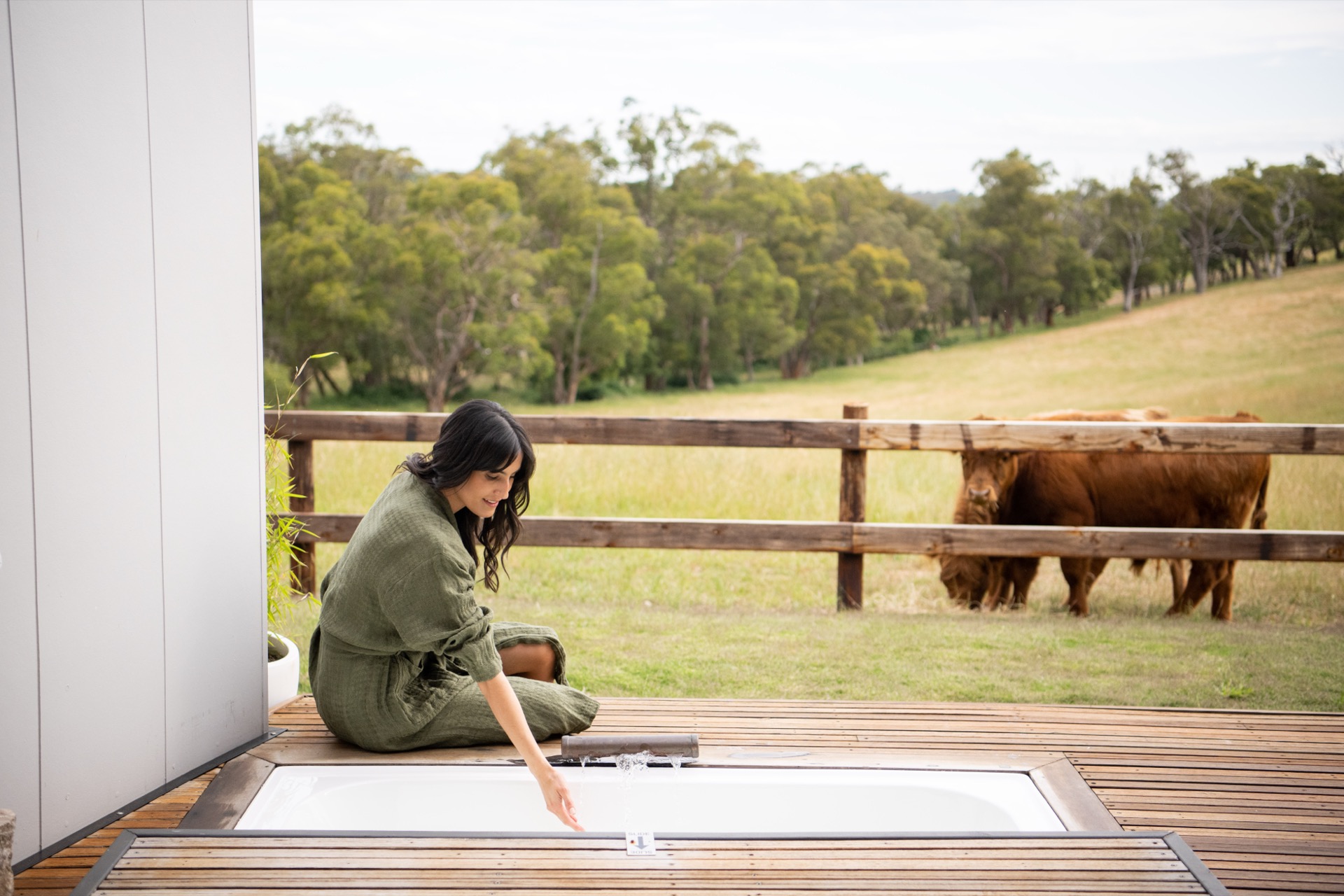
The freestanding bath is outside, under open sky. In winter, the water is hot, the air is cold, and the stars are sharper than they are in any other season. Winter skies in the Adelaide Hills are clearer — the conditions that make a bath feel less appealing are the same conditions that make it unforgettable.
Fill the bath after sunset. The water stays hot for a long time. Stay until your fingers prune. Watch Orion move across the sky. Listen to the possums in the gum trees.
There's a moment — about ten minutes in — when the steam is rising off the water and the cold air is on your face and your body is completely warm, and you realise you're not thinking about anything. Not work. Not the drive home. Nothing. That moment is what winter escapes in the Adelaide Hills are for.
Warm floors, quiet heat
The cottage has hydronic heated floors throughout. No fans. No noise. No dry air blowing across your face while you sleep. Just warmth rising from the ground, even and constant.
You'll notice it most when you get out of bed barefoot on a winter morning. The floor is warm. The coffee machine is waiting. The fog is still in the valley. There's nowhere to be.
This is not a small detail. Heated floors change the entire experience of a winter stay. You walk around barefoot in a cottage where it's 4 degrees outside. You don't layer up to go to the kitchen. You don't huddle under a blanket waiting for a heater to warm the room. The whole space is warm, evenly and silently, from the ground up.
The bed has quality linen and a proper winter-weight doona. The kind you sink into and don't want to leave. Winter mornings at Casa Luna start slowly. That's the point.
Empty cellar doors
The Adelaide Hills is one of Australia's great cool-climate wine regions. In summer, the cellar doors are packed — tour buses, hen's parties, families. The winemakers are busy pouring, and the experience is pleasant but hurried.
In winter, it's different. You might be the only people in the room. The person pouring your wine is often the person who made it. They have time. They'll open something that isn't on the tasting list. They'll tell you about the vintage, the vineyard, the frost that nearly ruined everything in September.
Shaw + Smith, The Lane, Deviation Road — they're all within twenty minutes. In winter, you get the version of these places that the locals know. The intimate version. The one where you leave with wines you can't find anywhere else because the winemaker liked you enough to pull a bottle from the back.
Winter is also the best time to visit the smaller producers. Murdoch Hill. Ashton Hills. Ngeringa. These are the cellar doors where you need an appointment in summer because they're booked out. In winter, there's room. The quality of the experience goes up as the temperature goes down.
Hahndorf in the cold
Hahndorf is three minutes from Casa Luna. In winter, the German heritage of the village makes more sense than it does in any other season. This is a place that was built for cold weather.
The pubs light their fireplaces. The restaurants serve heavier food — slow-cooked meats, rich sauces, warm bread. You can find mulled wine on the main street. The stone buildings that feel quaint in summer feel genuinely cosy when there's fog outside and a fire inside.
The Hahndorf Inn does a proper schnitzel that's better in winter. The German Arms has dark beers on tap and a fireplace that makes you forget you were planning to go anywhere else. Udder Delights has cheese that pairs with the red wines you picked up earlier in the day.
Walk the main street on a winter weekday. It's a different village — quieter, slower, more itself. The tourists thin out. The locals come back. The shops have time to talk to you.
If you're staying near Hahndorf, winter is when you get the most authentic version of the village. The one the German settlers would recognise.
Winter walks
The Adelaide Hills has walking trails that are at their best in the cold months. The air is clean. The light is low and soft. You don't overheat halfway up a hill.
Mount Lofty summit is fifteen minutes from Casa Luna. The walk from Waterfall Gully to the summit is one of the most popular hikes in Adelaide — and in winter, the waterfall actually has water in it. The track is cool and shaded, the ferns are lush, and the view from the top extends across fog-filled valleys.
The Heysen Trail passes through the Adelaide Hills, and winter sections of the trail are spectacular. You don't need to do a multi-day hike. A two-hour stretch through Mount George or Mylor gives you old-growth forest, creek crossings, and the kind of silence that makes you stop and listen.
Closer to home, the trails around Bridgewater and Stirling are gentle enough for an afternoon wander. Mount George Conservation Park is ten minutes away and rarely busy. In winter, you might not see another person.
Come back to the cottage afterwards. Put the kettle on. Light the fire. The contrast between cold air and warm house is one of the quiet pleasures of a winter escape.
Cook in
The cottage kitchen has a gas cooktop, good pans, a Nespresso machine, and everything you need to stay in for the night. The Adelaide Hills is full of farm-gate producers — cheese, olives, charcuterie, seasonal vegetables. Pick things up during the day, cook something simple in the evening, eat by the fire.
Winter is the season for cooking in. Pasta. Risotto. A slow braise if you're ambitious. The Stirling Market runs through winter on Sunday mornings and it's one of the best farmers' markets in South Australia — smaller than the summer markets but better quality, with producers who show up year-round because they care about what they grow.
Pick up Adelaide Hills cheese from Woodside Cheese Wrights. Grab bread from Lenswood or the Lobethal Bakery. Buy whatever vegetables look good. Cook something together, open a bottle from the afternoon's tasting, eat slowly.
Winter cooking in a cottage you don't have to clean is one of life's underrated pleasures.
Why winter works for couples
A winter getaway in the Adelaide Hills is not about making the best of bad weather. It's about choosing a season that suits a particular kind of trip — slow, warm, quiet, private.
The cold gives you permission to do less. To sit longer. To light the fire and open the wine and let the evening happen without a plan. There's no guilt about not being outside when it's 6 degrees and raining. You're supposed to be inside. You're supposed to be resting.
For couples, this matters. Summer holidays come with pressure — pressure to be active, to explore, to make the most of the weather. Winter strips that away. What's left is the thing you actually came for: time together without distraction.
A couples retreat in the Adelaide Hills in winter is the version of a getaway that works for people who are tired. Not tired of each other. Tired of everything else. The pace, the noise, the constant doing. Winter gives you the excuse to stop.
Availability and rates
Winter midweek availability is good, and rates reflect the season. If you've been thinking about a couple of nights away, the cooler months are the time to do it. You'll pay less, see fewer crowds, and get the version of the Adelaide Hills that the locals keep for themselves.
Midweek stays — Tuesday to Thursday — are the sweet spot. The roads are empty. The cellar doors are quiet. The property is at its most peaceful. And the rates are the best you'll find all year.