
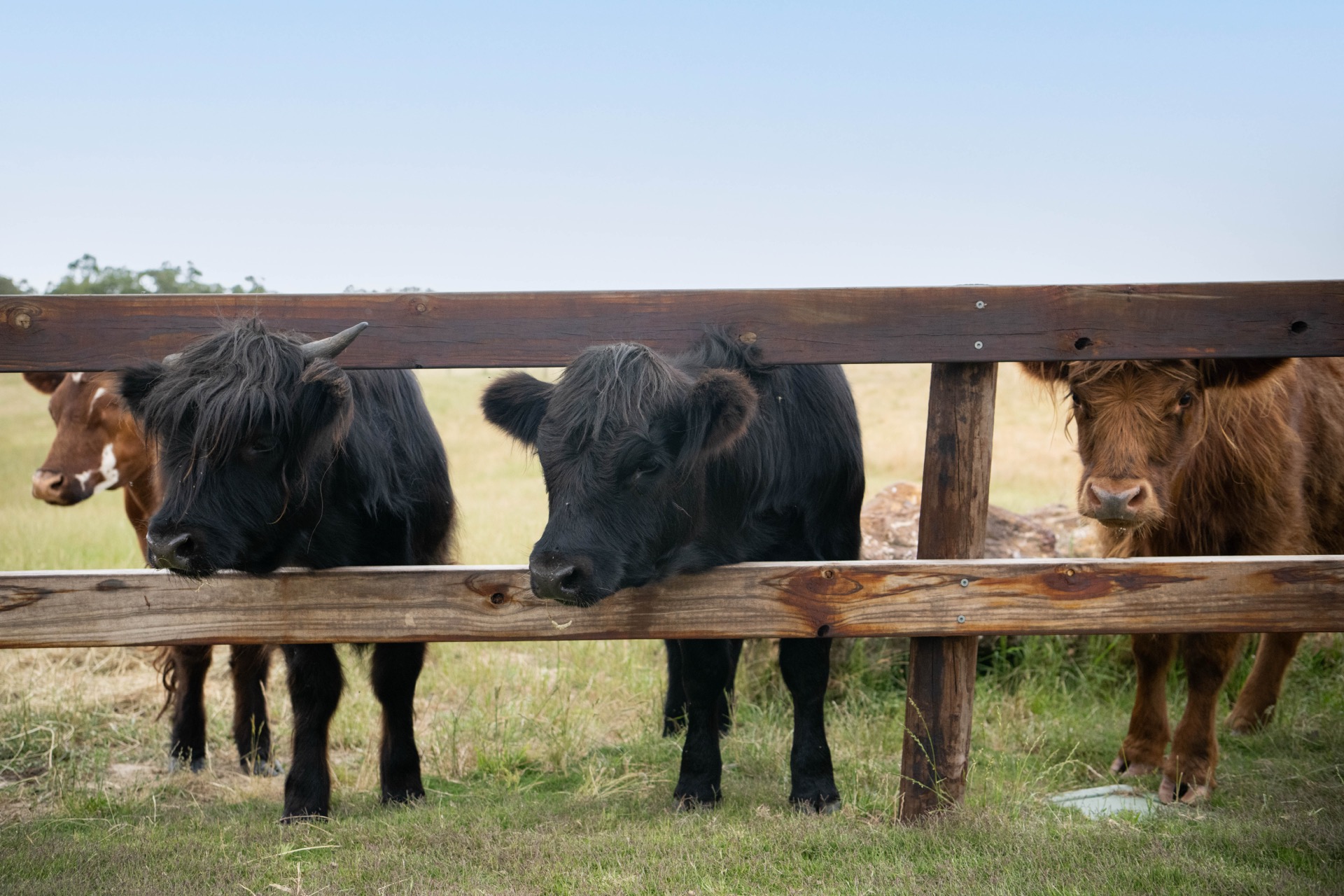
You hear them before you see them. A low hum through the morning fog. The soft tear of grass. Then, as the mist lifts off the valley, they appear — rust-coloured shapes moving slowly across the paddock, unhurried and completely uninterested in your schedule.
That is most mornings at Casa Luna. Coffee in hand, bare feet on the verandah, watching Highland cattle do what they have done for centuries. Graze. Wander. Stand in the rain like it does not bother them — because it doesn't.
Highland cattle are one of those animals that stop people mid-sentence. Guests who booked for the sauna or the outdoor bath or the wine region on the doorstep find themselves standing at the fence for half an hour, watching a calf figure out how its legs work. Something about these animals resets people. We've seen it hundreds of times and it still hasn't gotten old.
An old breed in a new place
Highland cattle are one of the oldest registered breeds in the world. The herd book dates back to 1884, but the breed itself is far older — shaped by centuries of Scottish wind, rain, and rocky ground. They were built for harsh country. Long, shaggy coats shed water. Wide horns that look dramatic are actually practical — used to dig through snow for food and to clear scrub.
The breed originated in the Scottish Highlands and western islands — places like Skye, Mull, and the remote glens of the northwest. The climate there is brutal. Wet, cold, windy, with thin soil and rough pasture. Highland cattle didn't just survive in those conditions. They thrived. While other breeds needed shelter and supplementary feed, Highlands stood in the open, coats streaming in the wind, eating whatever grew.
When people picture cattle farming, they usually imagine flat plains and dry heat. Highlands are the opposite. They come from a place that looks a lot like the Adelaide Hills in winter — green, wet, cold, unpredictable.
That is why they work here.
Why Highlands suit the Adelaide Hills
Our 12 acres sit in the hills at Bridgewater, where the weather changes its mind three times before lunch. Hot summers. Cold, wet winters. Frost in the mornings, warm by noon. Most cattle breeds would need supplementary feeding through the colder months. Highlands barely notice the shift.
Their double coat — a soft undercoat beneath that long outer hair — insulates them in winter and sheds out in summer. The outer coat is the longest of any cattle breed. It's oily, which means rain runs off it rather than soaking through. In the Adelaide Hills, where winter rain can be persistent and cold, this matters. Our Highlands stand in the paddock during downpours that would send Angus or Hereford looking for shelter.
They forage on rough pasture, eating grasses and plants that other breeds walk past. Thistles, coarse grasses, scrubby growth — Highlands eat it all. They do not need grain. They do not need lush, irrigated pasture. They work with what the land provides.
For a small organic farm stay in the Adelaide Hills, that matters. We wanted animals that could thrive without industrial inputs — no grain feeding, no growth hormones, no routine antibiotics. Highlands were the obvious choice. They are the breed that needs the least from us and gives the most back to the land.
The animals themselves
We run a small herd. Small enough that we know each animal individually. Their temperaments, their preferences, their habits.
There's Bonnie, who will walk up to the fence and stand with you, breathing warm air onto your hand, waiting for a scratch behind the ear. She's been here since the beginning and treats new guests with a calm curiosity that puts people at ease. There's Angus, who prefers his own company and watches you from across the paddock with a look that says he's thinking about it. He'll come over eventually. On his terms.
The calves are the ones that get people. Highland calves look like something from a children's book — all fluff and oversized ears and legs that seem too long for their bodies. They're playful in a way that adult cattle aren't. Running in circles for no reason. Headbutting fence posts experimentally. Standing in the middle of the paddock staring at a bird with total concentration.
Every calf has a different colour. Some are the classic rust-red that people associate with the breed. Others are black, or dun, or blonde. The variation surprises people who expect them all to look the same.
The horns develop slowly. Calves are born without them, and they grow over several years into the wide, sweeping shape that makes Highland cattle so recognisable. The horns are not aggressive. Highlands use them practically — to scratch an itch, to move branches, to establish gentle hierarchies within the herd. In all the years we've had them, we've never seen aggression.
Land managers, not just livestock
On an organic property, cattle are not just animals — they are part of how the land works.
Our Highlands graze rotationally across the paddocks. We move them between sections, giving each area time to recover before they return. This mimics the natural grazing patterns of wild herds and has measurable benefits for the soil and the grass.
They keep the grass at a height that reduces fire risk. In the Adelaide Hills, bushfire management is not optional — it's a responsibility. Well-grazed paddocks create natural firebreaks. The cattle do this work simply by eating.
Their hooves break up compacted soil, which lets water penetrate instead of running off. After years of rotational grazing, our soil holds more water than it did when we started. The grass is thicker. The worms are back. The paddocks drain better in winter and hold moisture longer in summer.
Their manure feeds the ground without chemical fertiliser. Highland manure is particularly good for pasture — the animals' varied diet means the manure contains a broad range of nutrients. We don't spread synthetic fertiliser on our paddocks. We haven't needed to.
This is not clever farming. It is old farming. The kind that worked for thousands of years before someone decided to improve it. The cattle manage the land, and the land feeds the cattle. We just move the fences.
Character, not just cattle
Here is what nobody tells you about Highlands: they have personality.
Each one is different. We have animals that will walk up to the fence and stand with you for twenty minutes. We have others that prefer to observe from a distance, chewing thoughtfully, as if deciding if you're worth the walk.
They are curious. A new gate, a different car, a guest walking a path they have not seen someone walk before — they notice. They will stop grazing and watch. Not startled. Just interested. Heads up, ears forward, a kind of bovine attentiveness that's hard to describe until you've seen it.
They are also remarkably quiet. People expect cattle to be loud. Highlands communicate in low rumbles — a gentle conversation drifting across the property in the early morning. Mothers talk to calves in a tone that sounds almost like purring. The herd moves together in near-silence, communicating through position and body language more than sound.
In the evenings, they settle. They find their spots — always the same spots, creatures of habit — and lie down in the grass facing the same direction. In winter, they tuck into the sheltered side of the hill. In summer, they find the shade of the old gums. Watching a herd of Highlands settle for the evening is one of the quiet daily rituals at Casa Luna that guests notice and remember.
What guests remember
We have hosted hundreds of couples since we opened. When they leave reviews, the cattle come up again and again. Not as a novelty. As a feeling.
There is something about waking up in a quiet valley and seeing animals moving slowly through the landscape that resets something in people. It is not a petting zoo. You cannot feed them or ride them. You just watch them live. And somehow that is enough.
One guest wrote that she sat on the deck for an hour watching a calf figure out how to scratch its ear with its back hoof. She said it was the most relaxed she had been in years. We understand that completely.
Another couple told us they had their first proper conversation in months while watching the herd move across the paddock at sunset. Not a big conversation. Just a quiet one. The kind that happens when you're both looking at the same thing and there's nothing else competing for attention.
The cattle come up in reviews more than the sauna. More than the bath. More than the views. We didn't plan that. It's just what happens when you put gentle animals in a beautiful place and give people the space to watch.
Highland cattle and the Adelaide Hills community
We're not the only people in the Adelaide Hills who have fallen for this breed. There's a small but passionate Highland cattle community in South Australia — breeders, hobby farmers, and people who just couldn't resist after seeing them at the Royal Adelaide Show.
The breed suits the hills perfectly. The climate, the terrain, the rainfall — it's as close to Scotland as Australia gets. Other Highland breeders in the region have told us the same thing: the animals arrived and looked like they'd come home.
The Adelaide Hills Highland cattle community shares genetics, advice, and an appreciation for animals that don't fit the industrial farming model. These are not commercial beef cattle in any conventional sense. They're slow-growing, small-herd animals that reward patience over productivity. The people who breed them tend to be the kind of people who measure farming success in soil health and animal welfare, not kilograms per hectare.
The philosophy of slow animals
We built Casa Luna around the idea that slowing down is not lazy — it is necessary. The property, the interiors, the pace of a stay here — everything is designed to pull you out of urgency and into the present.
The cattle fit that philosophy without trying. They do not rush. They do not perform. They just exist, calmly, in a beautiful place. Watching them is a reminder that not everything needs to be optimised or efficient or fast.
There's a reason animal-watching reduces cortisol. The research on it is clear — observing animals in natural settings activates the parasympathetic nervous system. Your breathing slows. Your heart rate drops. The mental chatter that follows you out of the city starts to quiet.
You don't need to know the science to feel it. Just sit on the verandah with a coffee and watch the herd. Five minutes in, you'll understand.
Sometimes the best thing to do is stand in a field and eat grass. Or, in your case, sit on a verandah with a glass of Adelaide Hills wine and watch someone else do it.
Seasons with the herd
The cattle look different in every season, and each version is worth seeing.
Winter is when they are magnificent. Full coats, breath steaming in the cold air, moving through green paddocks under grey skies. The long hair is at its thickest and most dramatic. They look like the photographs — the ones that make people say "I need to see these in person." Winter in the Adelaide Hills belongs to the Highlands.
Spring brings calves. New animals on unsteady legs, staying close to their mothers, gradually exploring further each day. The paddocks are full of wildflowers and the calves move through them like they're discovering colour for the first time.
Summer is the laid-back season. The coats thin out. The animals find shade under the old gum trees and wait out the heat with more patience than most of us can manage. Evening is their time in summer — they graze in the golden light and the paddock looks like a painting.
Autumn is transition. The coats start growing back. The herd moves differently, grouping tighter, preparing for the cold. The mornings are misty and the cattle emerge from fog like something from another century.
They are here year-round. They are part of the property. Part of the rhythm. And part of what makes a stay at Casa Luna feel different from anywhere else.
Come and meet them
You don't need to be a farm person to love Highland cattle. You don't need to know anything about breeds or farming or organic agriculture. You just need to be willing to stand still for a few minutes and watch.
They'll do the rest.
Book a stay and see for yourself. They will be here. They are not going anywhere.